Information
RECORD RETENTION AND DISPOSAL POLICY
POLICY STATEMENT
The Office of the Police, Fire and Crime Commissioner for Northamptonshire (OPFCC) will ensure that information is not kept for longer than is necessary and will retain the minimum amount of information that it requires to carry out its statutory functions.
INTRODUCTION
Retention periods are given in whole years and are from the end of the financial year to which the records relate. Records should be disposed of by arranging for collection of confidential waste for destruction or shredding, including all copies on whatever format.
Aside from the standard procedure, set out below, whenever there is a possibility of litigation, a request under the Freedom of Information Act 2000 or a Subject Access Request under the Data Protection Act 2018, any records that are likely to be affected should not be amended or disposed of until the threat of litigation has ended, the Subject Access Request has been actioned or the appeal processes under the Freedom of Information Act have been exhausted. In these circumstances the Monitoring Officer should be consulted.
This policy is designed to ensure compliance with the principles of storage limitation and data minimisation as outlined in the UK General Data Protection Regulation (UK GDPR). The OPFCC will not retain personal data for longer than necessary for the purposes for which it was collected or processed.
AIMS AND OBJECTIVES
This policy and standards will help the OPFCC to:
- Ensure the retention and availability of the minimum amount of relevant information that is necessary for the OPFCC to operate.
- Comply with legal and regulatory requirements, including the Freedom of Information Act 2000, the Data Protection Act 2018, UK General Data Protection Regulation (UK GDPR) and the other relevant legislation.
- Save employees’ time and effort when retrieving information by reducing the amount of information that may be held unnecessarily.
- Minimise the administrative overhead to the OPFCC and save money in terms of storage costs where hard copy information is taking up office space and electronic documents are using excessive storage capacity on computer equipment such as network servers.
- Ensure archival records that are of historical value are appropriately retained for the benefit of future generations.
STANDARD PROCEDURE
This procedure applies to records which do not need to be retained. Information which is duplicated, unimportant or of short term use can be destroyed under this standard procedure, including:
- compliment slips
- catalogues and trade journals
- telephone message slips
- non-acceptance of invitations
- messages or notes not related to OPCC business
- requests for standard information provided by the OPCC
- out of date distribution lists
- working papers which lead to a final report (including OPCC and
- decision making papers etc)
- duplicated and superseded material such as stationery, manuals,
- drafts, address books and reference copies of annual reports
- e-copies of documents where a hard copy has been printed and
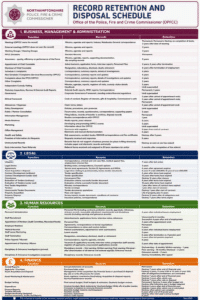
The following schedules set out the retention periods for particular records.